Name: Waldo
World: Cereal Mascots
Faction: General Mills Mascots
Magical Items: Red Balloons, Red Balloons with Yellow Star, Purple Bell, Orange Bridge, Green Clovers, Blue Diamonds, Clover Hat, Pink Hearts, Purple Horseshoes, Hourglass, Key, Magic Mirror, Blue Moons, Yellow Moons, Full Blue Moon with Yellow Smile, Pot of Gold, Gold Pyramid, Rainbow, Orange Stars, Yellow Stars, White Shooting Star, White Torch, and Blue Tower glyphs.
Waldo the wizard for a brief time in 1976 was the mascot for the Lucky Charms cereal. He replaced the Leprechaun, but was soon recalled when people demanded Lucky back.
Like Lucky, Waldo knew the secret of the shapes and new how to create magic with them. The Clovers had power over luck, the Balloons had power over levitation, Heart had power over life, the Horseshoes controlled speed, the Hourglass controlled time, the Moon had power of invisibility, the Rainbows controlled teleportation, and the Stars controlled flight.
Waldo and Lucky gained the power to control the seas when they subdue an angry whale. It is known that both have incorporated other magical glyphs for winter or competitive events. The Bell, Bridge, Pyramid, Torch, and Towers are some examples. The glyphs they hold can be combined to create various effects, not just the ones listed above. The extent of their power is unknown.
It is believed that Waldo may have left to deal with Count Chocula, Franken Berry, Yummy Mummy, Boo Berry, Fruit Brute. Rumor has it he managed to seal Yummy Mummy within the Gold Pyramid and used the power of the Blue and Yellow Moons against Fruit Brute. However, he was most likely captured by Count Chocula..
Wednesday, August 28, 2013
Tuesday, July 2, 2013
Responding to "The Many Worlds of D&D" Part 2
![]() |
| 5E Planar Set Up |
As explained earlier 5E D&D is coming up with a new model for the planes, which incorporates 4E & Classic Edition Ideas. Like Pathfinder's own interpretation, these models are very similar to that of the Celestial Spheres that early philosopher's came up with to explain the nature of the universe. As almost with all models the Prime Material Plane, our physical universe, seems to always be at the center. However, it only takes into account the planes as described in the now closed D&D universe.
Ironically, the proposed 5E planar model is very similar to a concept I have been working on which incorporates the sum of the d20 systems cosmologies and other gaming/storytelling systems. It incorporates the traditional Great Wheel of the Outer Planes, the Expanded Spherical Model of the Inner Planes, adds the revised Feywild and Shadowfell Transitive Planes, while incorporating the 4E Elemental Chaos in a twist to pay homage to original D&D. This is known as the "Con Clave" model. (Yes it has a triple meaning...1) Literal Translation means "With Key", 2) Refers to my internet handle, 3) Refers to the "Rule of Three" if you know my internet handle.)
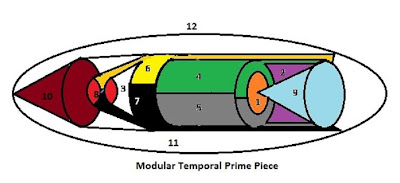
Keep in mind that this is just a 3D visual representation of a portion of a temporal thread. Each module is a small point on a timeline, each section connecting with one another via the Elemental Chaos and the Outlands Spire. At that junction is a thin membrane known as the Vortex Dimension, where Mystara's Immortal "Old Ones" dwell. Keep in mind the model rotates, as the energies of the Positive and Negative planes churn everything around. Here is the guide for the Modular Temporal Prime Piece:
1) Prime Material Plane: The Known Universe containing all campaign worlds.
2) Astral: Transitive plane, act as a buffer between the Prime Material Plane and the Outer Planes.
-Gate of Souls: Apex of the Outlands Spire that pierces the Astral. It is through this pinpoint in reality that souls pass onto the Outer Planes.
3) Ethereal: Transitive plane, acts as a buffer between the Prime Material Plane and the Inner Planes.
-Border Ethereal: Acts as permeable membrane in which matter and energy is bought forth from the Inner Planes. The Plane of Dreams here helps shape the Prime Material Plane, a portion known as the Phlogiston can be accessed to make interstellar travel faster.
4) Feywild: Transitive plane and buffer between the Positive Elemental Plane. This is the First World created by the gods and stretches into the Ethereal from which it was formed. The Feywild eventually becomes part of the Shadowfell, where the Unseelie dwell.. It anchors in the Outer Planes as Arborea/Olympus.
5) Shadowfell: Transitive plane and buffer between the Negative Elemental Plane. This is the what is left of the First World as the forces of Entropy consumes it, as it breakdown it often echoes the Prime Material Plane. Eventually though through cyclic movement it is renewed eventually in the Feywild once more. It anchors in the Outer Planes as Gehenna. It is believed through the influence of the Yugoloths, Ravenloft was created in the Shadowfell.
6) Positive: Portion of the Inner Planes, that is a fundamental state of the universe of growth. It's energies nourishes the Feywild, and connects directly to Limbo in the Outer Planes. (Why Limbo? Limbo is the ultimate expression of creativity, where reality is constantly in a state of flux)
7) Negative: Portion of the Inner Planes, that is a fundamental state of the universe of entropy. It's energies keeps the continual growth of the Feywild in check, and connects directly to Mechanus in the Outer Planes.
(Why Mechanus? Mechanus is the ultimate expression of Oblivion in the sense that it solidifies reality through the qualitative and quantitative nature of the plane.)
8) Inner Planes: The Inner Planes is where all matter and energy from reality are formed, it is buffered by the Ethereal Plane and threatened by the Elemental Chaos. At the very heart of the Inner Planes is the Well of Souls, were all life comes from. Traditionally the Inner Planes are composed of Six Elemental Planes: Air, Earth, Fire, and Water; Four Para-Elemental Planes: Ice, Lava, Ooze, and Smoke; Eight Quasi-Elemental Plane: Lighting, Mineral, Radiance, Steam, Ash, Dust, Salt, and Vacuum. Just as a side note Wood and Metal Plane are often overlooked. The Elemental Plane of Metal is the border between Earth and Mineral.
While wood is part of the Living Inner Planes.
-Living Inner Planes: The area in the center of the Inner Planes are the Living Inner Planes. The band twist and turns upon itself like a mobius strip. They are collectively known as the Planes of Flesh, Ichor, Spirit.
The Plane Ichor is found at the center, while Flesh is the mobius strip, and the void surrounding them is Spirit. These planes where first hinted at in Ravenloft and expanded from Warlands of the Accords RPG. Note that the Plane of Wood is part of the Plane of Flesh.
-Well of Souls: At the center of the Living Inner Planes is the "Wells of Souls" Here all spirits our created.
9) Outer Planes: The classic "Great Wheel" concept is kept, however the Outlands Spire is utilized more.
The Outlands Spire is the apex of the Outer Planes where all souls are funneled through. However, in reality the spire is a bulge in reality from Elemental Chaos. There is a thin membrane beneath the Outlands Spire, known as the Vortex Dimension. This area is part of the Temporal Prime and Far Realm, and is a gateway where reality can shift. On Mystara it is known that Immortal known as Old Ones can be found here, it is believed that these Old Ones are the energy remnants of dead gods, akin to what the Astral Planes does. These beings protect reality from the Far Realm Old Ones.
10) Elemental Chaos
That energy is from the Inner Planes is what give the momentum to move through time. Whatever force that birthed the Inner Planes, also created a force that seeks to extinguish the energies. The Elemental Chaos causes a bulge in the Outland in the form of the Spire. Oddly enough it can be access through certain layers of the Abyss. At the very bottom of it leads to the Vortex Dimension.
11) Far Realm: Is an expression of the 4th Dimension. As the multitudes of possibilities strain reality, it is expressed as the Far Realm. It is the end result of the interactions of the Positive and Negative energies constantly moving as well.
12) Temporal Prime: If you can clear the chaos of the Far Realm, one can identify the 3rd Dimensional Temporal Threads. Here time itself can be traversed, visits to alternate timelines, as well as alternate Primes.
When viewing the Temporal Thread in 4D you can see multiple phantom images of the same thread. The thread frays out and splits, tangles, and merges as the forces of probability and conformity struggle.
Monday, July 1, 2013
Responding to "The Many Worlds of D&D" Part 1
The other dimension or planes in the D&D Universe is something that every character seems to have a fond memory of. For most the other planes are the legendary places of the afterlife where gods, demons and devils dwell. For wizards and adventurers they are places where one can readily explore, as they are just adjacent dimension on which our reality is built upon. As 5E is attempting to raise D&D from unlife, a new article "The Many Worlds of D&D" attempts to preview what may happen.
When D&D was first created, the idea of these realms where rather simple. Plane of Energy, Plane of Entropy, Plane of Matter, Plane of Time, and Plane of Thought. These various planes contained other areas in which certain gods or worlds existed. In addition it explained our universe as we know it, a large place full of possibilities.
As AD&D came into being, the 5 Modular explanation of the planes was redefined into what we call "The Great Wheel". It said there were three major areas: Inner Planes, Prime Material Plane, and the Outer Planes. As a buffer around the Prime Material Plane, there are the ethereal and Astral Planes, which allowed the prime not to be heavily influenced by primal elemental energies or divine forces. The concept of the great wheel was carried over from 1st Edition to 2nd Edition with minor changes, mostly going into detail upon the planes themselves. This culminated when an entire campaign setting was developed known as Planescape, which set the benchmark for the planes.
When the Golden Age of 3rd Edition and the d20 Universe came along, the "Great Wheel" model was still uphold. However, due to the fact that the d20 system was inclusive to other genres and world, it did allow some measure of reinterpretation. New areas were discussed like the Far Realm and the First World of the faerie, even the new campaign setting Eberron bought hints of new mechanics involving the planes. The "Great Wheel" is consider a balanced approach, while other interpretations were accepted as well. The models of the Great Tree patterned after the Yggdrasil of the Norse Pantheon, The Great Mountain from the Roman-Greco Pantheon, The Great Pyramid from the Mayan Pantheon, Grecian Celestial Sphere model, The Twin Rivers of Darkness and Day from the Pharonic Pantheon, and even the original Immortals 5 Planar Realms were accepted. People forget that d20 allowed the greatest freedom of interpretation. As the main theme of this era was that you the player's were truly in control of your world, not the game mechanics.
Sadly the great divide came when d20 was forced to shut down, and the 4E spewed forth. Much of it was saved an honored by its successor, Pathfinder. However, the ruinous 4E era bought forth an alternate prime material plane of Oerth, and destroyed the Great Wheel. The Astral Sea replaced much of the Outer Planes, while the Inner Planes were redone as the Elemental Chaos which collapsed into the Abyss. Some of the transitive planes like the Plane of Shadow was renamed the Shadowfell, and the faerie plane became the Feywild. It shook some things up and is attempting to reconcile with 5E.....
Reason for this article is in the defense of Spelljammer, the for mentioned article seems to treat this campaign setting as a problem. Spelljammer takes the terrestrial fantasy D&D campaign into wildspace. The author claims one of the biggest failing was the fact that you could travel to any D&D world. That in my opinion was one the best reasons you could get it, bypassing planar travel! It also started you thinking on the influence of gods...in how a cleric power was affected by wildsapce travel. The "Phlogiston" was also an interesting explanation of deep space. One could simple see that area as "Hyperspace", when a spelljammer shifts to an area of the border ethereal allowing them to cover the distance between systems in a shorter length of time.
Spelljammer is a great setting which is worth a try, especially if you like sci-fi dramas, but with Asteroid Dungeons and Stellar Dragons!
Sunday, May 26, 2013
Mystara: Hollow World
Based within Dungeons & Dragons Mystara's Campaign Setting, the Hollow World is a place where ancient civilization have been preserved. The Immortal Ka created the whole world as a refuge from creatures that began to disappear from the surface of the world. As more and more things changed on the surface, Ka and others decided that cultures needed to be preserved as well besides disappearing animal species. Soon various cultures appeared in the Hollow World. Most are unaware of the transition and exists in a perpetual state of cultural stagnation, they are at the peak of the civilization but are unable to advance or adapt concepts that never known to them. Sadly a few culture like that of Blackmoor were unable to be saved. Much is this is do to the Spell of Preservation cast on the interior of the world. Although new civilization have been added, any interaction within another cultures is usually met with hostility. Those that have traded have been compelled to trade item that they would use in their culture. New things can be introduced from another society, but will always be considered a novelty at best and never integrated into the culture. However these civilization are threatened by invaders from the surface world from time to time. Shadow Elves and others that have found their way in have wreak havoc on some of the preserved nations..
The various civilization known to dwell with the Hollow World are:
-Brute-Men
-Nethar
-Oltec
-Azcan
-Blacklore Elves
-Beastman
-Kogolor Dwarves
-Antalian
-Jennites
-Tanagoro
-Traldar
-Makia
-Nithia
-Krugel Orcs
-Milnians
-Kubbits
-Flamaeker Gnomes of Serrainne
-Sind
-Soderfjord Gnomes
-Hin
-Ierendi Pirates
The Hollow Worlld of Mystara can be entered from various caverns found throughout Mystara. However there are two large openings at the northern and southern poles. Both poles are covered by an area of thick heavy fog. The oceans and seas of Mystara and the Hollow World are connected, thus many underwater creatures and civilization will be familiar. The Spell of Preservation though keeps these underwater civilization from changing too. The Hollow Earth is lit by the core of Mystara, a large ball of reddish plasma which illuminates the world in a perpetual state of none. A series of land masses orbit the core, and provide brief period of darkness for section of the inner surface. Fortunately the weather system is very similar to the surface world, as clouds form and provide some relief from the constant daylight. Some of land masses that orbit around the core are also inhabited by a few civilization as well.
The greatest secret of the Hollow World is a massive library known as the Lighthouse. The area of the Lighthouse is an exception to the effects of the Spell of Preservation in the sense that, it is place were knowledge is accumulated and can be exchanged freely. It contains a collection of nearly all mortal knowledge from various points of history and cultures. Individual scholars journey here to contribute the vast library and study from it..
Saturday, May 25, 2013
Dangerous Journeys' Mythus: Inner Aerth
Dangerous Journey's Mythus Campaign setting was created by Gary Gygax. The campaign for the "Epic of Aerth" focuses most on the surface world. However Aerth, unlike it's counterparts, is a hollow planet.
The surface of Aerth is only 1,000 miles deep,and two major openings can be found at the northern and southern poles.Aerth's outer and inner oceans though do not connect, for Inner Aerth all the land masses we know on the surface are oceans, and all the known surface oceans are landmasses. The Artic Sea on the surface hits the polar ice sheet Of Inner Aerth. In the middle of the continent of Antartica, the polar ice sheet of Inner Aerth meet.
Access to Inner Aerth can be found throughout the world through deep cave systems, but it from deep underwater or through Aerth. The Interior is light by a small sun or the planet's core which seems to be free floating. This means that Inner Aerth knows no night, perhaps except at the poles which at best may have some twilight. Fortunately Inner Aerth is frequented by much precipitation, cloud systems generate at the pole and produce storms and weather patterns. What shade comes from these systems, bringing some change to the constant noon time illumination.
From those explorers who have returned from Inner Aerth, we know that much of the world is populated by animals of a bygone era. The northern and southern polar areas, familiar mammals can be found. In addition, several extinct surface species can be found here as well. Ranging from the great saber-tooth cats to the Wholly Mammoths. The equatorial regions contain even stranger creatures, which have been identified at best by some Heka practitioners.These creatures are giant reptiles, called Dinosaurs, from four ancient time period of the past. In addition to these reptiles there are also a number of giant insects as well one should be aware of. The seas likewise contain manner such dangers from these time periods as well.
It also has been reported that there are a few intelligent races here. Three of these races resemble hairy humans, and have erie similarities to the northern barbarian peoples Azir and Aerope. These two are known as Cro-Magon and Neanderthals. The third race is called Pithicanthopiod, which resemble the orange hairy men of the tree of the islands of South East Azir The last race is nonhuman and dubbed Theriopodid. These individuals have been observed to live in the mountainous regions of the equatorial Inner Aerth. They resemble humanoid reptiles, very similar to the dinosaurs in coloration.
Saturday, April 13, 2013
Dungeon Bastard: One DM's opinion is another man's comedy
If you fan of Youtube and EN World, lately you may have come across the Dungeon Bastard aka Bill Cavalier. He is a D&D/Fantasy RPG enthusiast who since 2011 created a site and video series in which he dispenses his wisdom of all things RPG "D&D" to the world. He claims the title "Adventure Coach" and his resume on his sites explain why he is so awesome. Here is a sample of the Wisdom he so often gives....
he is kinda of an in your face curmudgeon and no nonsense approach...so be for warned.
Ironically the advice that is dispensed by the "Adventure Coach" is often munchkin-ense. It is not about the adventure or journey of a character(s), but more of what experience and awesome loot did I get for that kill?
He is highly entertaining in most of his "advice" or "learned observations/experience", it is thought provoking and worth of conversation and a few chuckles. Although I stand on many different points of opposition to his "wisdom", he is entertaining and puts himself out there which is respectable in its own merit.
Let's take his video on the Flumph. It appears the "Dungeon Bastard only has access to a few sources of information, as he wips out "ye olde" Fiend Folio circa 1979. I will assume for the sake of argument that he is using the source material because it is as "canon" as one can get. However as a counterpoint, the information on the Flumph was expanded upon in Monstrous Compendium Annual Two (1995), Dragon Magazine #246 (1998), and Misfit Monsters (2010). The Flumph like many original creatures is technically not a "Monster", but an NPC race.
In the 1998 and 2010 references of the Flumph, it has been observed to be a race of non-humans that are extra-terrestrial in origin. The beings encountered in said dungeons were most likely low level adventurers exploring and defending itself peacefully from an attacking player character party. Matter of fact he does touch on the inspiration of the race to the Lovecraft Mythos. If you know about the Flying Polyps and Mi-go, well Flumphs fit right in. Also to note that the Sesame Street "Martians" closely resemble a Flumph.
H.G. Wells "War of the Worlds" also resemble a Flumph. Also let us not forget SNK "Mars People" from Metal Slug series are Flumph like too.
Yet again, the "Dungeon Bastard" is meant as entertainment......so what doe my opinion mean after all.
Wednesday, March 20, 2013
Famous Spellcasters: Nuitari
![]() |
| Representation from the "The Seventh Seal" |
World: Krynn aka "Dragonlance Campaign Setting"
Pantheon: Pantheon of the Gods of Evil
Spells: Unknown.
Magical Items: Nuitari's Shroud, Staff of Nuitari. Tome of Nuitari.
Nuitari is the god of magic, specifically regarding the use for personal power. In the aftermath of the All-Saints War, it was decided as part of the peace accord that that each would have an influence over magic.The gods good and neutrality ushered in their children, while Sargonnas and Takhisis spawned Nuitari whom they fought over. According to the myth, Takhisis forced Sargonnas to bear the birth of Nuitari gestation in a great golden egg. When the time came for it birth, Takhisis came and fought Sargonnas for control. In the end, the young deity was almost destroyed. In his true form he is pale, his voice horse from the struggle of his parents, and body almost worse from neglect. Never the lease, Takhisis still saw his use. Also during this time, the Greygem was created with the essence of Ionthus. Who in eons would unleash magic into the world.
He was appointed to oversee magic, and its use for the application for evil. He was partnered with the other gods of magic, whom he quickly grew close to. His cousins, Solinari is the champion for the gods of god and Lunitari is the champion for the gods of neutrality. They soon decided that magic should be above the petty squabbles of the gods as they sought to abuse and control it. They formed a pact with each other to all remain true magic itself. However, several things on Krynn threatened this balance. The Greygem was released from it's location and soon spread uncontrolled magic throughout the world. The second were the Dragon Wars which threatened the world itself. Seeing that the gods and their followers abused magic, in addition to threat of sorcery, they instructed their followers to enact a ritual that would create the moons of Krynn sometime at the end of the First Dragon War. The moons themselves allowed the gods greater control over the influence of magic and they began to spread the ways of wizardry among the people.
He does his best to make sure the gods of evil do not abuse magic, but Sargonnas and Takhisis at times have forced Nuitari to agree to their terms and have even held the gods hostage at time.
Nuitari took the dark moon, the smallest and closest to Krynn. The moon itself is ebon in color and revolves around Krynn every 8 days. It can only be seen by those with evil hearts or those who draw upon magic. On the moon, Nuitari has a private tower which he watches Krynn from. The moon both exists in the prime material plane and the ethereal plane. Few expeditions have been attempted, but it is a a harsh place that is seeming devoid of animal life. The rock here is dark, and the few plants here are dark green mosses and sparse dark green trees. The few inhabitants on the physical moon are usually stranded there, and what life forms thought to have been observed are ooze like creatures. Nuitari's domain on the ethereal landscape is dominated by the tower which is rarely seen.
Subscribe to:
Posts (Atom)


